Important

The WHAT'S NEW! page contains the latest medical updates. If you're wondering how I'm going as far as health is concerned, this is the place to start. Latest: Wed 27 Nov 2013. 7.20AM

Monday, February 27, 2012

Where the wild things ought to be (3)


The Night of the Slut

It's children's bedtime, and I'm reading nursery rhymes to two little girls; old rhymes that are quirky and whimsical, something like this funny little verse in the Big Book of Nursery Rhymes:


  And then I start reading this one, not having read ahead:


   "What's a slut, Dad?"

  I would be sure to have been asked by one or the other of those little girls, or both. Inquisitive little devils, they were.

  So what are you going to say, Dad?

  Of course, that would have been 25 years or more ago, if I had read that verse. The 'Slutwalk' appropriation of the term that's happened recently, with its strongly serious message and undertones, reminds us how a word's meaning can veer off from a past understanding of its intent.

  I've no intention of getting into the current debate here. It is championed by more articulate people than I and I leave it to them. Words are fluid in their use and no-one should be surprised when they push different buttons in people's consciousness at different times in history – or if, for that matter, they are deliberately chosen to carry a message.

  That's what happens to language. Words that are still regarded as obscene today (a diminishing number, admittedly) were in regular use in polite company at various times in the past.

  But it was not all that long ago that 'slut' carried a less harsh meaning than it does now. As with other words, it depends on how barbed the arrow is.

  Used with intent to wound, there is still probably no more hurtful and degrading word, I'm sure, than for a woman to have it thrown at her, in spite of the strong moves in the recent past to rehabilitate it and give it dignity. Today it's seen in a more strongly sexual context than it did, and not all that long ago. Now it conjures up a very recent imagery.

  The word 'slut' derives from 'slattern,' which is in the same group as 'slovenly.' In this nursery rhyme, the meaning of 'slut' is far more associated with that group: 'careless' or 'lazy.' Or dirty. The nursery rhyme carries this intent – an insult more often than not hurled by women at women who failed to conform to the standards of the day.

  But 'dirty' too is a loaded term. It has always been linked with relaxation of the sexual rules at best, or further down the moral scale, to licence or depravity. Dirty books. Movies. Jokes. Or illicit sex, not conforming to what were often prim, proper or puritanical standards supposedly the hallmark of an earlier era, especially the Victorian one.

  There's no clear separation in the meanings for the term. Licentious, naughty, dirty, cheeky, inappropriate, sexy, lazy, untrustworthy, willful, slovenly. All terms aimed at women, the real meaning dependent who it's aimed at and who's aiming it.

  The illustration for the poem shows a female (a very little, very innocent one) standing at the bath, so I could easily tell my little daughters that in the olden days, it meant someone who should have bathed every day, as they did, rather than wait till the end of the week as this one did, the naughty little grub. I'd have added that it's not something they should call any other person these days, or it could make them very angry.

  But... it's not really the whole story. Could it not also be about a woman who in those days waits till the end of the week not only to wash her body, but the family's clothes? There were days in a Big House (think Downton Abbey!), when washing, ironing, polishing and dusting were done to a fairly strict weekly routine.

  Social classes tend to ape their betters, and even in a working class family of an earlier era, woe betide the slatternly non-conformist girl or woman sitting in the sun smoking a cigarette in her scarf, dressing gown and slippers, way past breakfast time.

  'Oh, the slut!' a neighbour secretly envious of the "slut's" failure to conform might say.

  'Yes, a slut indeed,' the disapproving wife's husband might well echo, angry and frustrated that his prim and proper lady couldn't be a bit more like the pretty neighbour at times, sitting on the doorstep lazing in the sun.

  Here's the mañana lady who epitomised it all a half-century ago – though slightly more glamorous, scrubbed and non-Latino than the next door neighbour or the Mexican belle she's supposed to be portraying. Both Peggy Lee and the neighbour are probably equally unavailable to Mr. Righteous the Disapprover; hence his anger is fueled by her "sluttish" behaviour.

  Who knows how that resentment might manifest itself? Welcome to the 21st Century.


To go to A Man for All Tongues 

Sunday, February 26, 2012

Where the wild things ought to be (2)


I was reading a book of nursery rhymes the other day, as you do.

  The reason is that I wondered how many I remembered from my childhood of the large collection in front of me, and was well pleased that I knew the majority of them. I don't mean 90%; but more than half. There are some there that are gems I've never seen before.

  Still, it's a goodly number, considering how many rhymes are there.

  Then I asked myself exactly why I knew so many. Most of them derive from the nineteenth century or a good deal earlier – Tudor times at the latest, as we know from some of the references to the Black Death, and Mary Queen of Scots, Humpty Dumpty etc.

  I won't go into how so many are veiled references to important political figures of their era, parodied, lampooned and derided, as these analyses have all been done before.

  But reading them now I can see how many also poked fun at social figures, men and women, with plenty of sexual overtones that would escape children completely – though not their parents, particularly at the time of the rhyme's invention, I'll bet.

Don't tell me this was what the gentlemen were after!

  The reasons why there are so many stuck in my head vary. One is that our house was full of books of one sort or another, suitable to our ages as we grew up.

  Mum knew well, instinctively, the enormous worth of verse and song, rhythm and rhyme, and how valuable they were to our neural development.

  Thus she read and sang them to us and we sang them with her while looking at the pictures. Links and associations developed in our brains and cemented memories there. The alphabet was learned with no effort. Pre-TV Sesame Street in our own accent, some nursery rhymes were.

  All sorts of children's games also played their part, linked as they were to verse and rhythm. Some in the 1950s which we thought utterly harmless would be very incorrect politically these days. My sisters will readily remember one clapping game that starts:

Mary Mack,
Dressed in black
Silver buttons down her back
She likes coffee
She likes tea --
(And supply the final line, girls!)

Or the rhyme to choose something:

Eeny meeny miny mo....
(You know how it goes. Of course you do!)

A lot of these games were girls' games, but in a small country town there was a good deal of cross play. I had three sisters and many girl cousins, and in the spare time in the weekend, boys and girls would often play the same games, whether rounders or skipping. When numbers were short and you needed a backstop in rounders, it didn't pay to be too choosy.

  All the girls had their personal skipping ropes, but the best fun in skipping was communal.

  We boys were a bit funny about this, as it was pretty much a girl's art, but sometimes a strange fancy took us all and we'd decide to play as well.

  The girls didn't mind. Society was still strongly gendered; the Swinging Sixties were yet to arrive. This was one thing they surely proved publicly that they did better than the boys. They were happy to demonstrate it and remind males of their inferiority in these quite physical pursuits.

  Some girls were expert at turning the long heavy ropes in perfect time. We learned to run 'in' without stopping the rope, and skip in time, along with five or six or more others. As with all things, there was an art to this and the skill didn't always come easily.

  As well, the girls sometimes got two ropes and the turners interwove them, turning one clockwise with one hand and anticlockwise with the other - a bit like an egg-beater only different....

  That action doubled the pace and the skill required. Even to 'run in' without stopping either rope was quite a challenge and required split-second timing and coordination.

  I wonder if they do this at schools these days, anywhere, or if the 'double-rope' skipping is a thing of the past? I hope not. Maybe it still exists in country schools, or is more widespread than I think. It's the sort of thing multicultural schools in the cities just might have reimported with the arrival of some new culture group.

  I'm guessing. It was so good for kids in so many ways. No wonder we were lean and healthy. Or plump and healthy.

  Just healthy, yes. Many a somewhat plump little girl could skip all day.

  The point of all this is that songs were always sung to go with the skipping game, whichever one was chosen, and quite a few of them were based on the old nursery rhymes too, so it's hardly surprising that we never forgot them.

  Now this brings me to the surprise package in the Big Book of Nursery Rhymes. Or is it really so surprising, or outrageous?

  I refer to the slut! I contend, Yer Onner, that it's much less outrageous than we might think.

  Next time, final part. I promise. Scout's honour. Hey, here it is!


All images come from the online version of The Big Book of Nursery Rhymes, available at http://www.gutenberg.org/ebooks/38562

There are various formats, but I recommend highly installing a Kindle Reader program on your PC or Mac computer (you don't need to own a Kindle Reader tablet) and enjoy the beautiful illustrations as well.

Saturday, February 25, 2012

A Journey in Other Worlds

by John Jacob Astor

Snippets from the Gutenberg Collection: free downloads 2012


"The Signals from the Arctic Circle"

.
I have to call this a fantasy rather than science fiction. There is no recorded date of publication but it's clearly around 1900. 

What I find interesting is how much it reflects the character of its age. As the reference to a jolly good hunting trip on Jupiter indicates, it's more like a safari to Africa than to another planet: the Darkest Africa so beloved of the glory days of European colonialism and imperialism. The idea of the 'draining of the swamps' to make the land 'productive' is in the best late Victorian mercantilist tradition.

At the same time, its illustrations also indicate the influence of Darwin's The Origin of Species - or perhaps The Voyage of the Beagle even more so.

It's a fascinating snapshot of an age of romance, self-assurance, and pride in inventive science. I hope you enjoy the design of the spaceship. Clearly the concept of the bullet fired into space was the best way (the only way imaginable at the time) to escape from earth.


"A Battle Royal"

.
Here's the tiny excerpt:

✵     ✵     ✵     ✵     ✵     ✵

Until the Callisto entered the planet's atmosphere, its five moons appeared like silver shields against the black sky, but now things were looking more terrestrial, and they began to feel at home.  Bearwarden put down his note-book, and Ayrault returned a photograph to his pocket, while all three gazed at their new abode. 

Beneath them was a vast continent variegated by chains of lakes and rivers stretching away in all directions except toward the equator, where lay a placid ocean as far as their telescopes could pierce.  To the eastward were towering and massive mountains, and along the southern border of the continent smoking volcanoes, while toward the west they saw forests, gently rolling plains, and table-lands that would have satisfied a poet or set an agriculturist's heart at rest. 

"How I should like to mine those hills for copper, or drain the swamps to the south!" exclaimed Col. Bearwarden.  "The Lake Superior mines and the reclamation of the Florida Everglades would be nothing to this."

"Any inhabitants we may find here have so much land at their disposal that they will not need to drain swamps on account of pressure of population for some time," put in the doctor.

"The Combat with the Dragons"

.
"I hope we may find some four-legged inhabitants," said Ayrault, thinking of their explosive magazine rifles.  "If Jupiter is passing through its Jurassic or Mesozoic period, there must be any amount of some kind of game."


"The Journey Home"


✵     ✵     ✵     ✵     ✵     ✵

A Journey in Other Worlds by John Jacob Astor


Downloadable free in various formats from gutenberg.com

Friday, February 24, 2012

Fairy tales, facts and fantasies


There is a story in Hans Andersen's Fairy Tales that I particularly remember. You may know it if you were brought up on with these tales, as we were. It's called The Tinder Box. I'm betting the older you are, the more chance there is that you've read it.

  Perhaps it was the illustration in our edition as children that first took my fancy. It featured a gnarled dead hollow tree, a soldier and a hump-backed old woman, no doubt referred to then as a crone; the sort who was a likely candidate for classification as a witch in medieval times. Women like her were burnt at the stake watched with morbid fascination by a public eager for entertainment, and probably a great deal of glee by a neighbour of high public profile with an eye to acquiring her property.

Sadly, not our original version
  Just to be sure, I found the story and re-read it. Until I did that, I didn't realise how much of the story had settled in the dark recesses of my memory. But it's there. As I've discovered, I have lost nothing I have ever learned; I just fail sometimes to recall it.

  The story comes back to me as I read it; every word, every phrase, every mental image. If only it were so easy to drag back to the forefront of memory! That's the tricky bit.

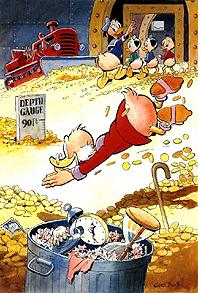
  The only part I do remember well is relevant here. A soldier is asked by this old woman, who in the story I see now is indeed called a witch, to go down into the hollow tree where there is wealth below. He agrees, and finds a room as full of copper coins as is Scrooge McDuck's money bin with cash.

  Happy at this, he fills his knapsack with as many as it can hold, but then decides to visit the next room. He finds it full of silver coins, so empties out the coppers and refills the knapsack with silver. He decides to risk going into the third room (as each room is guarded by a fierce dog), and you will be astounded to learn, no doubt, that it is full of gold and jewels. Once more he gives the contents of his knapsack the flick, and stuffs it with the choicest of the riches in the third room.

  The story really heats up after this, with gory things happening, as they do in these sorts of fairy tales, and has a happy ending of course, as they also do, except for the victims of various murders and executions; but what I've described already contains the moral of my tale below.

  If you've been following my posts to any extent you will probably become aware that I've developed something of an addiction to gutenberg.org  Daily I've gone through what's been released each 24 hours, and found some wonderful things in the oddest of volumes.

  I wanted to share some of them with you, so I read those that appealed to me (sometimes purely on instinct). I took some trouble to extract a tiny bit from each, together with illustrations where there were any, and started building a collection.

  What happened was that I carefully edited these, and planned to release them at intervals, but I am like the soldier with his knapsack. The more I read, the more I feel the need to throw away some of the older excerpts stacked away in my knapsack of curiosities.

  Where I differ from the soldier is that I am reluctant to throw any of my riches away, even the copper coins as it were - but I will have to.

  It's impossible to know what will appeal to you most, but I'll keep the excerpts very short. I wasn't harsh enough in my editing with the one on snuff, but I think I've learned my lesson, and what will come should entertain you, especially with pictures!

  One is coming up shortly, if I can hold the grey matter in my skull together for long enough. Very shortly....

Tuesday, February 21, 2012

Our family farm in the 1950s (5)


This is the final part of my mini-series on milking the cows.

  By the end of Part 4, I finally managed to get milk into the cans; now let me tell you about the final stage for one milking session.

  By the time I could really help, we had acquired one other essential piece of equipment. A car. A brand new 1957 Holden ute, i.e. paid for in full with a cheque on delivery from Anderson's Motors. 

I've colorised the Holden! This is "Surf Green"

  Paying something off was a concept never envisaged in Dad's world. You bought something only when you had the cash for it showing in the bank account. Until then, you did without it. Nor would you buy something second hand. That was inheriting someone else's trouble, in his book.

  'Surf Green' it was, according to the Holden colour chart. I'm not sure surf is that colour, but it was close enough. NBT 372 was the number plate. 'No Bloody Trouble' it stood for, Dad would say with pride. The ute changed our lives a great deal for the better.

  EnnBeeTeeThreeSevenTwo was backed up to the shed 'cargo bay', and we'd load the milk cans into the back. Each can had a brass plate welded on, the owner's name stamped neatly on it. 

  The milk cans were solid and heavy on their own, which they needed to be. 

  Full of milk, they weighed quite a bit for a kid of 10. Lessee now, remembering my school tables, the cans would weigh say 10 lbs at least on their own, a gallon of milk weighs 10 lbs, 10 gallons to a can, so 110 lbs per can to move from the dairy fridge into the tray of the ute.

  That's 50 kgs for you decimal babies. Throw that around just by grasping two little handles, without removing one of your bare toes, chillen.

  No wonder I once had biceps and triceps from milking the quadrupeds - quintessentially, dare I say? (This sentence would have been my entry for the Bulwer-Lytton awards, were it not for the fact that they are for fiction, not narrative.) And little wonder, with those muscles, I was able to break School Bully's arm owing to an Affair of Honour at High School.

  Sigh. Look at those arms now.... No, don't. You'd never guess these days.

  By the way, the winner in the purple prose section of the 2011 Bulwer-Lytton competition was this:
As his small boat scudded before a brisk breeze under a sapphire sky dappled with cerulean clouds with indigo bases, through cobalt seas that deepened to navy nearer the boat and faded to azure at the horizon, Ian was at a loss as to why he felt blue.
  But I digress, I confess, no remorse for the mess. Now I return:

  The milk was handed over at the depot. We kept our own record of how much milk went out daily in the various sized cans we had. The empty cans would be back at the depot down-town by late afternoon, steam-sterilised at the Butter Factory after they emptied them. 

  At least we hoped they were sterilised, but you couldn't take a chance on that. Strange things have found their way into food containers, haven't they? We re-washed them scrupulously before milk went into any of them. Lots of boiling water and CalHypo were required.

  On that subject I must add this. When our milk arrived at the PCD, samples were taken routinely every few weeks, and a bacteria count done. Mostly, the milk passed, but a few times I can remember, disaster struck. It may have been just that the can tested had a higher than usual count, but whatever; if your sample failed the test, when you came to pick up the empty cans in the afternoon, you'd find your entire day's milk production returned in full. One-seventh of the week's income was gone.

  But that wasn't the worst of it. This was a crisis. It meant that before next milking the following morning, all the milking machine components; many metres of pipes, teat-cups, vats, buckets, the shock-cooler, cans - anything that came into contact with the milk from udder to can - would have to be dismantled, sterilised by a complicated manual process I won't go into here, and reassembled before dawn the following day.

  Hurricane lanterns would be set up for the night's work (no electricity, don't forget!), tons of water boiled in a copper over a wood fire, and the job worked on non-stop till it was done.

  The only beneficiaries of the disaster were the poddy calves, who would be given as much of the creamy returned milk as they could hold (this milk was not contaminated, and all farmers know by the smell when milk is even slightly off.) The calves' bellies stuck out like balloons afterwards; they must have welcomed the rare change from skimmed milk. 

  What they couldn't drink was poured into the troughs for the pigs to squeal and bicker over. Jeez, pigs are... pigs. And if you think your kids have turned their bedrooms into a pig-sty, then you've never been near a real pig-sty. Stay upwind, that's my advice.

  One last thing on this crisis. If you had your milk returned, they tested it thoroughly every day for a week to ensure that the bacteria count was down to their acceptable levels. It was an anxious week for the farmer, as another return would have been unthinkable. 

  A second failure in a week never happened to us. Few bacteria would have survived what we did to them after a milk return. If there were one miserable bacterium in there somewhere, it would have been damned lonely.

  But back to a normal milking session. Any milk left over beyond our quota would go to the cream separator, and be given to the poddies, and the cream collected. What we did with that I'll tell you another time maybe.

  You might think that's the end of a milking. No such luck. The really tedious bit now begins. All the equipment had to be given a normal clean and sterilisation, and there was a lot of it. The bails had to be swept out with a yard broom, or swilled out in mucky weather. The yards themselves had to be cleaned. I'd have the inglorious but necessary task of shovelling any newly created cowmuck into a barrow, and from thence to the manure heap. And boy, can't sixty or so cows produce some, in the hours while they wait to be milked! Barrowloads.

  Finally, it would all be done, by about 10 am on a Saturday morning if we were lucky. Having taken part in half the milking, done most of the washing of equipment such as the myriad of cream separator bits and other tidying up, Mum would scoot off home to cook a proper breakfast for the workers, if Jan and Lyn weren't then living at home. Of course, if they were, they would have done as many household tasks as possible by the time Mum came home, including meal preparation, but everyone worked to full capacity. Idlers would have got short shrift at Sunny Hills.

  There were plenty of other farm jobs to be done after breakfast; fencing, ploughing, farrier work on the horses, digging and watering the vegetable patch, periodic mustering and dipping.... no end to it.

  Oh, let me remind you. Most of what I've described in the previous two parts was just one morning's work. At 2 pm on the same day, the whole process would start again. Think on that.

  That's twice a day, every day, of every week, rain, hail or shine. Farmers don't get holidays. Nor do farmers' wives, unless you count having babies as holidays. [I hear loud howls of protest. OK, I withdraw that remark.] Nor do their kids get much of a break, as often as not - except for school. And none of them can afford to get sick.

  So. When you're sleeping in on a Sunday morning till noon after a leisurely Saturday and a massive night out, give a thought to the farmers presently being screwed by the big retailers into getting the lowest possible return for the relentless labour of an entire farming family. 

  If any group ought to be bolshie, it's those on the land. Where's that bloody guillotine? And don't you dare try to remind me that 1789 came before 1917 - I escaped from the farm by becoming an historian, m'kayyy?

Monday, February 20, 2012

Snuff and nonsense


They were all into it, you know. Addison, Bolingbroke, Congreve, Swift, and Pope, e.g., - the whole lot of them! They were all hooked on snorting the finely ground-up weed. Tobacco.

This is an extract from England in the Days of Old by William Andrews. I think you might like it. Snuff is good for your kids, for a start. So it says. Read on....

(EXCERPT) 

The Age of Snuffing

In this country old customs linger long, and although the age of snuffing has passed away, in some quarters the piquant pinch still finds favour. Our ancient municipal corporations have been reformed, but old usages are still maintained and revived.

In 1896 we saw an account in the newspapers of an amusing episode which occurred during a meeting of the Pontefract Town Council. One of the aldermen, noticing that the councillors had "to go borrowing" snuff, suggested the re-introduction of the old Corporation snuff-box.

The official box, in the shape of an antler, was unearthed from underneath the aldermanic bench amidst much amusement, and the Mayor promised ere another sitting the article in question should be duly cleaned and replenished with the stimulating powder.

Not snuff, but he snuffed it
Sir Albert K. Rollit, the learned and genial member of Parliament for South Islington, when Mayor of his native town of Hull a few years ago, presented to his brother members of the Corporation a massive and valuable snuff-box. The gift was much appreciated....

In bygone times taking snuff was extremely popular, its palmy days in England being during the eighteenth century. Snuff was praised in poetry and prose. Peer and peasant, rich and poor, the lady in her drawing-room and the humble housewife alike enjoyed the pungent pinch. The snuff-box was to be seen everywhere.

The earliest allusion we have to snuffing occurs in the narrative of the second voyage of Columbus in 1494. It is there related by Roman Pane, the friar, who accompanied the expedition, that the aborigines of America reduced tobacco to a powder, and drew it through a cane half a cubit long; one end of this they placed in the nose and the other upon the powder.

He also stated that it purged them very much.

Snuff and other forms of tobacco on their introduction had many bitter opponents. After the Great Plague the popularity of tobacco and snuff increased, for during the time of the terrible visitation both had been largely used as disinfectants.

There is a curious entry in Thomas Hearne's Diary, 1720-21, bearing on this theme. He writes as follows under date of January 21:--
"I have been told that in the last great plague in London none that kept tobacconists' shops had the plague. It is certain that smoaking was looked upon as a most excellent preservative. In so much that even children were obliged to smoak. And I remember that I heard formerly Tom Rogers, who was yeoman beadle, say that when he was that year when the plague raged a schoolboy at Eton, all the boys in the school were obliged to smoak in the school every morning, and that he was never whipped so much in his life as he was one morning for not smoaking."

Pepys says in his Diary on June 7, 1665:--
"The hottest day that ever I felt in my life. This day, much against my will, I did in Drury Lane see two or three houses marked with a red cross upon the doors, and 'Lord have mercy upon us!' writ there; which was a sad sight to me, being the first of the kind that to my remembrance I ever saw. It put me into ill-conception of myself and my smell, so that I was forced to buy some roll tobacco to smell and chew, which took apprehension." ...
... Preachers of all sections of the religious world delighted in a pinch of snuff. Sneezing was heard in the highest and humblest churches, and it even made St. Peter's at Rome echo. The practice so excited the ire of Pope Innocent the Twelfth that he made an effort in 1690 to stop it in his churches, and "solemnly excommunicated all who should dare to take snuff."

Tyerman, in his "Life of Wesley," tells us the great trouble the famous preacher had with his early converts.

"Many of them were absolutely enslaved to snuff; some drank drams, &c., to remedy such evils, the preachers were enjoined on no account to take snuff, or to drink drams themselves; and were to speak to any one they saw snuffing in sermon time, and to answer the pretence that drams cured the colic and helped digestion."

Mr. Wesley cautioned a preacher going to Ireland against snuff, unless by order of a physician, declaring that no people were in such blind bondage to the silly, nasty, dirty custom as were the Irish. It is stated so far did Irishmen carry their love of snuffing, that it was customary, when a wake was on, to put a plate full of snuff upon the dead man's, or woman's stomach, from which each guest was expected to take a pinch upon being introduced to the corpse.


(END OF EXCERPT)

What have the following two illustrations to do with the above? Nothing, but they were in the same volume, and I found them curious.


http://www.gutenberg.org/ebooks/38905

Saturday, February 18, 2012

That splendid England!


Imagine a parcel of books being dropped on your doorstep every morning. You don't know what they are till you open the package. All you know is that they are not just any old books... well, there's a fair chance they could be old; much more than a hundred years old.

  I have a pleasant time each day, if things go right, opening this electronic parcel and seeing what's in there. I've got several lined up to share excerpts with you at a later stage, but the paintings below are twenty of the best from a fascinating book published in 1914. The text of this book is also engaging as a top-down view characteristic of the period.

  I'll say no more, but if you have an eBook reading program on your computer, you can read the text as well as all the paintings, and see how England looked through the eyes of a gentleman just before World War 1 broke out.

The captions are taken directly from the text, including the spelling, so don't be surprised if it's a little different here and there from today's.

  I hope you enjoy viewing them as much as I did selecting them.

England by Sir Frank Fox


Richmond, Yorkshire

Norman Staircase, King's School, Canterbury

A Kent Manor-House and Garden

A Sussex Village

The Bridge of Sighs, St. John's College, Cambridge

Broad Street, Oxford, looking West

Harvesting in Herefordshire

Cricket at "Lord's"

Trout-fishing on the Itchen, Hampshire

Dean's Yard, Westminster

Sailing Boats on the Serpentine, Hyde Park, London

Watergate Street, Chester

Thames at Richmond, Surrey

Spring by the Thames

Glastonbury Abbey, Somersetshire
  
Anne Hathaway's Cottage near Stratford-on-Avon

Gipsies on a Gloucestershire Common

The Tower from the Tower Bridge, looking West

Hyde Park, London

Changing the Guard

Friday, February 17, 2012

Walkin' the walk


I don't quite know why it is, but every time we go on our walk around the streets of Armidale, we meet someone we know.

  Well, I do have a fair idea really, given that Armidale has a population of about 25,000 or so and I've been here over 35 years. The mathematics of probability on that count combined with the fact that I've been heavily involved with more facets of life here than the Hope Diamond has cut into its surface will readily explain this.

  We'd barely left the house and were about to cross the street when we saw a car approaching, about 100 metres away. At my velocity that's probably equivalent to about 10 metres in your case.

  It was the only car within sight, so we crossed to the middle of the street as the car approached, waiting for it to go by so that we could complete the three metre trek to the other side of the roadway.

  The car slowed to a crawl as it approached us.

  'What the hell?' I said to Tracey, 'why doesn't he just go on? Is he wanting us to cross in front of him?'

  He didn't. Instead, the car drew level with us and stopped as the window rolled down. He must want directions, I thought, remembering vividly our experience giving directions about a fortnight before.

  There was a face at the window I dimly recognised as one from a distant past; twenty years or so at least.

  'Hello,' he said, as if we meet like this every day. 'I thought it was you. I live in the flats about four doors down from your house. I've been there since 1984.'

  'Really? I thought you were working in Queensland.'

  'On and off.'

  Amazingly, and I want this recorded for posterity, I remembered his name, and introduced him to Tracey. She was standing near enough to the rear of the vehicle to inhale the exhaust gases emitted by his car's idling motor, so wasn't too keen on an extended conversation. We were on our walk, after all. Sadly, no car was coming up behind to assist in this process of moving him on.

  Don't get me wrong now; it was nice to be able to say hello after all that time, and he's a good chap who wishes me nothing more than the best.

  'I hear you're in a bad way,' he grinned breezily.

  'I've been better.'

  'So what do you do?'

  I study advanced calculus. I ride racehorses and win buckjumping competitions in Gunnedah, cut down virgin forests with a very large chainsaw, teach street fighting and mountaineering, and practise tantric yoga when it's raining. I am guru to a flock of animists.

  No, that's what I would have said if I had my brain in gear for proto-witticism, not focused on putting one foot after the other.

  'I read and write a bit. And I walk. Matter of fact, we better keep moving on.'

  'OK. Good to see you. We might meet again!'

  He revved the engine and was gone.

  In a bad way. No-one had put it quite like that to me before, not that I minded. It's not inaccurate. He'd been in Queensland long enough to be blunt about such things.

  We set off.

  From the point of view of walking, the early part of the walk is comparatively easy.

  What people with motor-neurone disease, brain injury or stroke recovery will understand, as well as those whose brain motor centre doesn't work properly because of interference by a brain tumour, is that something as simple as walking - which we all take for granted till we can't do it - has to become a conscious process.

  That means you have to think about each part of the operation as you do it.

  As I walk up the hill, the right foot might drag once or twice. I adjust.

  More angle in the knee.

  Then, as the muscles tire, more thought has to go into other joints.

  The hip.

  Now, adjust the direction and height of ankle movement.

  Now the ball of the foot. Push harder with the toes and the foot muscles. And bend the knee in the middle of the step. Not quite that much.

  All these actions aren't simultaneous. They're microseconds apart, and need thinking about - in the right order!

  Each step. Always each and every step. Lose concentration and the limp is pronounced. Or the foot drags.

  Arm movement. You wouldn't imagine it would matter, but without thinking about it as well, it can lose synchronicity with the legs, with implications for balance. Without it, I may veer to the left or right.

  I watch for humps and bumps in the road. Half a centimetre vertically makes a difference. Don't allow for it, and we're back to dragging the foot or doing the drunk impression.

  We're at the top of the hill and the path is horizontal. All the angles for the foot now change, just enough to feel unsteady after the climb. Adjust. Focus.

  Now we're going downhill. In some ways, this is harder than going up, especially as the hill gets slightly steeper. All the muscular and tendon relationships change. I feel unsteady.

  At the kerb to cross the street, I take Tracey's arm.

  This is very steadying, but it also fosters dependence. It gives me a false sense of balance. As soon as we get to the other side, I let go of her arm.

  She walks just slightly ahead, always on the left. She knows that if she's on the other side, if I trip and start to fall, my right arm won't respond fast enough to catch hers, and doesn't have the strength to help save a fall.

  Don't think for a moment of walking on the grass. It has more traps than you can imagine.

  As the walk comes to the last half, there's a new element aimed at defeating me. The muscles down the right side of my torso start to tire.

  The effect of that is similar to aiming a large heater at the right side of a snowman. I begin to list badly to starboard. I have to think about forcing my body straight, as there's really nothing physically weaker about the side; mainly the problem gets to be the slowing of or interference to the signals from the brain.

  Now, in order to maintain balance unassisted, I have to think about staying upright continuously, as well as my arm movement, the hip, the knee angle and direction, ankle lift and strength, to push off the toes; and the spot where the foot will land.

  Little wonder that when we reach home, I can barely lift the leg to plough through the thick carpet of kikuyu lawn, and make it up the stairs. Just three of them. Standing still at the door is quite unsteadying. I'm glad to sit down. Tracey brings me a glass of water.

  That's today's walk. Tomorrow's may be easier or it may not. Each day is unpredictable that way.

  One thing's for sure. If I have a seizure before the next walk, it will be back to the drawing board for the mechanics of walking, and next time, the whole walking process will need re-adjusting.

Tuesday, February 14, 2012

Where the wild things ought to be (1)


For many years, my mother was a Teacher-Librarian. That is to say, she was a teacher who, after classroom teaching for some time, was appointed Librarian of the South Gladstone Primary School, and her role was to teach children the joy of books, not just to organise the school library.

  At the time, I was also beginning my first years of classroom teaching, aged 18. While she taught at one school in the town, I taught at another, Gladstone Central.

  When we came home after school, she would regale me with stories of the children in her library classes. One of them was an unfortunate boy (or fortunate, if you're a devoted Presley fan) who was named Elvis. Elvis Stanley. And, out of thousands over the years whom she taught in the Library, she also taught another lad whose parents, we believed, couldn't make up their minds which way his name should be spelled. Spelt. Whatever. He was named Stepheven and that's what was on his birth certificate.

  Now it just occurred to me that there really may be a legitimate name 'Stepheven' and our reasoning all these years could have been wrong. So I check with the oracle, Google. Sure enough, it is a name, and obviously not quite as uncommon as I still think it ought to be. There is e.g., a Stepheven Lord on FaceBook, but you don't need the poor chap's details. Check it out if you must. Google is your friend.

  Oddly enough, at Gladstone Central I taught a Stephen Lord, whose parents had the good sense to spell his name as I have. I remember him because he'd transferred from New South Wales into the Grade 4 class I was teaching, and started cursive writing in their style a year or two earlier. It was unattractive spiky style, and he had to learn cursive all over again to suit our Queensland copybooks. He resented this deeply.

  And then it occurred to me after my checking on the existence of Stepheven as a real name that there are probably scores of Elvis Stanleys in a world of seven billion people, given that both Elvis and Stanley are fairly common names, and sure enough, Google tells me there are plenty of them. 

  One, I see, is an unfortunate who was murdered just a couple of weeks ago. The poor chap owned the Love Shack Bar & Grill on St Kitts, and Clayton “Massive” Thomas denies plotting to kill him. If he didn't, someone sure did.

  I sincerely hope it wasn't our Elvis who was shot dead in the Love Shack Bar & Grill in the Caribbean; but then, if it's not, there's still one Elvis Stanley who saw in the New Year 2012 and failed to get any further than the end of the first month.

  But I digress horribly from my tale within a tale within yet another tale. Fortunately the parents of Stepheven had determined that his name should be pronounced 'Stephen,' and I say "fortunate" for obvious reasons. So let that be....

  My mother often narrated the story of Stepheven (or "Steve-even" as she called him at home), and his joy at reading the recent books she was ordering for the library.

Source
  Amongst them was the then-newly-released Where The Wild Things Are, by Maurice Sendak.

  It's a wonderful book and I'm sure many of you who have or have had or happen to be kids of the right age will remember it well, as it was a favourite with my girls - and let's be honest, a tale I never minded reading to them.

  I can't say I was as keen on other more girly books. I won't say which, but I read them just as enthusiastically, I believe. Fake sincerity and you've got it made; if I may I paraphrase from George Bernard Shaw's Man and Superman.

  My mother believed that kids knew better than adults which books they wanted to read and that almost the only thing you had to do for a child was give them a love of books and reading. If they were read to, and if they wanted to read for themselves and could, they were set for life - providing they knew their basic maths tables. She didn't dissuade us from reading comics - whatever we wanted to read, even jam-tin labels - she'd never stop us. It's interesting what you could learn from old jam-tin labels, anyway.

  She was not a fan of the terrible formula-style books of the 1950s being churned out by some publishers, and as an artist herself, wanted truly creative books for children, both in text and artwork. This was why she was so affronted at what happened when I exchanged my book with that of Alan Long (a very short tale you might to read.)

  My mother shared the joy of kids like Elvis Stanley when they grappled with the words accompanying the brilliant Sendak illustrations. Elvis was far from a brilliant reader, at the time at least. If you're reading this, Elvis, then you've just proved my point; you've made it into the high art form of blogging, so don't be offended. My mother was on the right track.

  So now I emerge from one of my tales within a tale to mention a fascinating letter by Ursula Nordstom that I came across today, which tied in so perfectly with my mother's philosophy on kids and books. The piece is better told in its own context, but I'll extract just one paragraph, which says enough to complement this story of mine:
A Witty and Wise 1953 Letter from Legendary Children's Book Editor Ursula Nordstrom

  by Maria Popova

"Did I ever tell you that several years ago, after the Harper management saw that I could publish children's books successfully, I was taken out to luncheon and offered, with great ceremony, the opportunity to be an editor in the adult department? The implication, of course, was that since I had learned to publish books for children with considerable success perhaps I was now ready to move along (or up) to the adult field. I almost pushed the luncheon table into the lap of the pompous gentleman opposite me and then explained kindly that publishing children's books was what I did, that I couldn't possibly be interested in books for dead dull finished adults, and thank you very much but I had to get back to my desk to publish some more good books for bad children."
  My mother was on just that wavelength, as indeed she was when she taught painting to the very young and the very old and many in between. Again, a similar story of inspiration and triumph on the micro-scale of human achievement. Another time perhaps.

  Now where was I? There were a couple of other asides, like the adult book I decided to read at the age of twelve that pained my mother when she saw it, because she knew I wasn't ready for it... but I can come back to that another time, if I get the chance.

  The truth is, what I really wanted to talk about was a slut in a book of nursery rhymes, but you'll have to wait now. This time around I've used up all my current brainpower on these Tristram Shandy-ish expeditions.